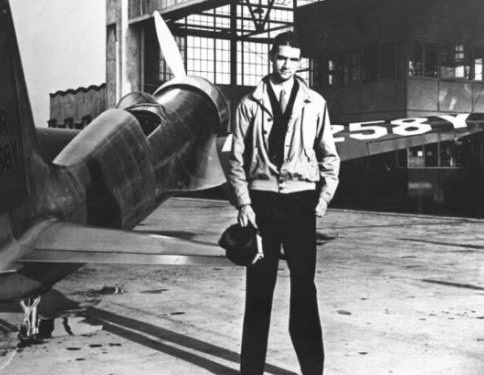
Howard Hughes — a cult figure not only in Hollywood but in all of America — was a mysterious man. An official American legend and a man who embodied the American dream. This man became the world’s first billionaire, entered the Guinness Book of Records, invented flight attendants, built a wooden airplane, was rumored to have been involved in the assassinations of Kennedy and Watergate, launched the first television satellite, set a world speed record for piston-engine aircraft. He was simultaneously a “gray cardinal,” a super-businessman, and an eccentric, somewhat resembling Salvador Dalí — a man who bought Las Vegas and planned to buy the entire country. His name was forbidden to be mentioned in official U.S. government reports. He was nearly forgotten for thirty years, after which Hollywood decided to tell his story. Several films have been dedicated to him, including The Aviator. The film is certainly interesting, but some facts from Hughes’ life were distorted, which is why it did not win an Oscar… It seems that even after his death, people treat him and his life with a strange bias.
Howard was born on December 24, 1905 (Capricorn, born in the Year of the Cat). Ancient Indian annals describe those born at this time as indecisive, changeable, and unreliable, unable to remain within the generally accepted behavioral norms. They constantly experiment and find particular pleasure in living on the edge of the permissible. They do not need serious or stable relationships, yet they can enter into a long union — provided the partner does not demand compliance with norms and rules. This description fits Howard perfectly, who at 17 fell in love with 23-year-old actress Eleanor Boardman and suffered a fiasco, then at 19 married wealthy Houston heiress Ella Rice. Instead of traditional pre-wedding gatherings with friends, Hughes wrote a will in which he tried to protect his future wife from his capital. Four years later, the young couple divorced, and Howard, leaving Ella to weep and mourn her failed life, went to Hollywood to conquer the world of cinema.
Having become an orphan at an early age, he inherited a huge fortune, which he invested in film production. His first film was so bad it never made it to the screen, but the second brought some profit, and the third gained wild popularity. Hughes was also the producer of the films Scarface and The Outlaw, which played a significant role in cinema history. The fact is that all of Hughes’ films were on the edge of what was permissible — the allowed level of violence, the allowed level of sexual explicitness. All of them were the subject of fierce disputes and even court cases between the censorship commission and Hughes. All were box office hits and gained scandalous fame. Thus, by the time he was not yet 25, Hughes had already become a well-known and significant figure in Hollywood.
Hughes titled his film about World War I pilots Hell’s Angels, produced it himself, and directed it. During filming, he learned to fly and spent two to three hours in the sky every day — there he felt absolutely happy (in his cosmogram, three planets and the South Node were in the air sign Aquarius).
His women were the most beautiful actresses of Hollywood: Katharine Hepburn, Ava Gardner (former wife of Frank Sinatra), Bette Davis, Marilyn Monroe, Jane Russell (the owner of the legendary bust, for which Hughes designed a special bra), and Jean Peters, who became his last wife. The degrees of his cosmogram are very telling:
Sun in the 3rd degree of Capricorn — excellent prestige, intelligence, caution, a degree of calculation, planning, and scientific abilities.
Retrograde Mercury in the 16th degree of Sagittarius — scatterbrainedness, mistakes, futile energy loss.
Mars in the 28th degree of Aquarius — a man who allows himself everything, complete depravity, danger of suicide.
Pluto in the 22nd degree of Gemini is in opposition to the Sun and Moon, Mercury and Venus in Sagittarius, and in the degree of the fall of Capella — makes a person ambitious yet strange, responsible for speed, records, and long-distance flights. Hughes loved speed, flew across the ocean himself multiple times, meaning his life was connected to the concept of speed, freedom, and flight.
Lilith in the 8th degree of Taurus — (degree of solitude) forms trines to the Sun and Neptune; he had a persistent illusion that solitude suited him well.
Neptune in the 10th degree of Cancer — success in business, secret societies, a degree of occultism, the use of secret means.
Saturn in the 29th degree of Aquarius — fortune, a passion for travel, an ability for tragic arts.
Jupiter in the 28th degree of Taurus — great appetites in life, excessive ambition, the desire to dominate everyone and everything, and failure as a result.
The second part of his life — he was punished for it.
South Node in the 23rd degree of Aquarius — activity, several unpleasant changes in life.
North Node in Leo (23rd degree) — “Germany” — a great Janus, a person who attracts others, shines, and dominates, but does not reveal himself.
Uranus in the 5th degree of Capricorn — danger of falling (he survived four plane crashes), recklessness.
Having established himself in Hollywood, Howard began buying up Texas and Nevada — and everything he bought brought him new money. Hughes acquired fifteen hotels and most of Las Vegas’ casinos, an airfield, abandoned gold and silver mines, golf courses, a television station, a huge Krupp ranch, auto repair enterprises, the governor of Nevada, and the state prosecutor. The half-billion Hughes brought to Las Vegas soon multiplied sixfold. But this was only the beginning — Hughes seriously intended to buy the United States. He did not need to purchase the entire country; buying the president would have been much cheaper, and he did buy him… Howard Hughes did not read stock reports or follow the market, yet the ideas that led him to the western United States worked perfectly. His brilliant business intuition never failed — new opportunities arose on the outskirts of the U.S.
Hughes had an unusual sense for everything new: he was the first to realize that the future lay in fine electronics, rockets, satellites, and nuclear reactor equipment. He understood that production was better moved to remote areas, far from the attention of big business, where taxes were lower, authorities were more accommodating, and labor was cheaper. This bore fruit: in just a few years, Howard Hughes became one of the most influential people in the country. American politicians stood in awe of him. To Richard Nixon (a paranoid), Hughes seemed dangerous, but the temptation was strong — Nixon, as before, took money from the all-powerful billionaire and wondered what Hughes would demand in return and what he would do to a debtor who could not please him.
Despite his financial genius, Howard always revealed his complexes in relationships with women; he feared getting close enough for a woman to manipulate him, so instead of marrying, the millionaire paid prostitutes who were interested only in money. One of these “call girls” infected Hughes with syphilis in the early 1930s, which went undetected for twenty years. Neglected syphilis, combined with increasing doses of codeine, gradually destroyed the already unstable psyche of the billionaire. From the 1950s, Hughes’ mental state deteriorated rapidly. He suspected that some ill-wishers were gathering information about his mental instability to have him declared incompetent through the courts and strip him of control over his fortune. To dispel rumors, he decided to marry demonstratively. Actress Jean Peters, who married Hughes in 1956, became his second and last wife. After the wedding, Howard almost every evening took Jean to the cinema, buying out the entire hall so no one could disturb their viewing. When he learned that the same hall screened a series for Black people in the morning, the millionaire threw a tantrum and never went there again. Blacks, like germs, terrified Hughes down to the smallest tremor.
Gradually, the millionaire’s delusions intensified. When he heard that an actress he had dated years earlier had contracted trichomoniasis, Hughes soaked his clothes — from ties to underwear — in alcohol and ordered servants to burn them, along with the rugs she might have stepped on. When a friend of Jean’s suffered from liver colic, Hughes quarantined his wife for two weeks. His close associates and subordinates fulfilled any whim of the billionaire, further reinforcing Howard’s delusions. Jean Peters recalled that when she headed to a café, guards sent by Hughes had to wipe the table and all dishes with disposable “Kleenex” wipes. The millionaire himself wiped his face and hands with such wipes almost every hour. Hughes several times fled from imaginary enemies — first to the Bahamas, where “Mormons carried him out of the hotel at night on their hands, wrapped in a blanket,” then to Nicaragua, and later to Mexico… The fact is that his retrograde Mercury (consciousness) is conjunct two conflicting fixed stars: Lesath, which brings persecution mania, the danger of insanity, escape from reality, asocial behavior, and solitude (one can be lonely even in marriage), and the danger of mountains; and Rasalgethi, which brings purposefulness and a sense of order, which is why it prevented Hughes from completely degrading and losing his mind.
In his final years, Hughes lived in a second-rate hotel and almost stopped going outside. He communicated only with seven Mormons personally selected by him for their neatness and chastity, who were ordered to enter his room in rubber gloves and touch him only through several layers of disposable napkins. When Hughes “fell ill,” he was given “pure” Mormon blood transfusions, and he “recovered.” His temperature was measured hourly, and he received injections. There was nothing in his room that could accumulate dust — only a film projector, a chair, a bed, and a notepad with a pen. A circle was drawn in chalk in front of his door, and visitors had to stand within it. Even Hughes’ doctor was forced to diagnose him without stepping out of the circle. Hughes never touched documents, doorknobs, forks, or knives with his bare hands. He ate only chicken broth and vanilla ice cream, and by the end of his life, he almost stopped eating, as even distilled water seemed “too dirty” to him.
Howard Robard Hughes died on April 5, 1976, during a flight from Acapulco to Houston, when the transiting Moon in Gemini conjunct his Pluto — the planet that largely governed his actions, monumental fame, and power. The transiting Moon formed an opposition to his natal Moon, April’s Sun was conjunct Lilith in square to his Sun (spirit), destructive Mars afflicted his Sun (heart), and transiting Neptune conjunct his natal Mars in Aquarius — death occurred in the element of air, which he loved so much…
Valentina Vittrok