It so happens that relationships between men and women are full of surprises and unexpected turns. No wonder the idea emerged that each had originated from different planets. Now, as descendants, we strive with incredible persistence to explain our partners’ behaviors, seeking answers—some in psychology, others in mysticism. In horoscopes, one may encounter the concept of the “vector ring.” What is it? What is it made of, and does this ring actually exist? Let us try to clarify this now.
As is known, the Chinese zodiac consists of 12 signs. At the end of the 20th century, thanks to Grigory Kvashe, a marriage horoscope was born, based on interactions between representatives of the Chinese zodiac. By analyzing the characteristics of each sign, he succeeded in constructing an entire system explaining and analyzing unions of different signs. In his marriage horoscope, 144 combinations are described, of which 24 form the group known as the vector ring.
Why did G. Kvashe isolate the vector ring? And what exactly is it? The vector ring, being the most powerful phenomenon, resists general analysis. It is also impossible to explain or subsume under a common law a couple belonging to the vector ring. They have their own law, one defining property—Servant and Master.

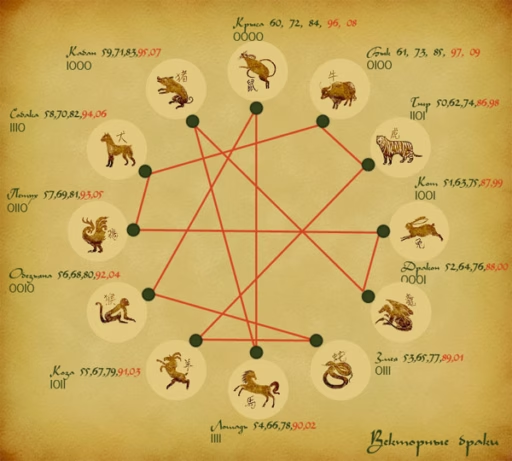
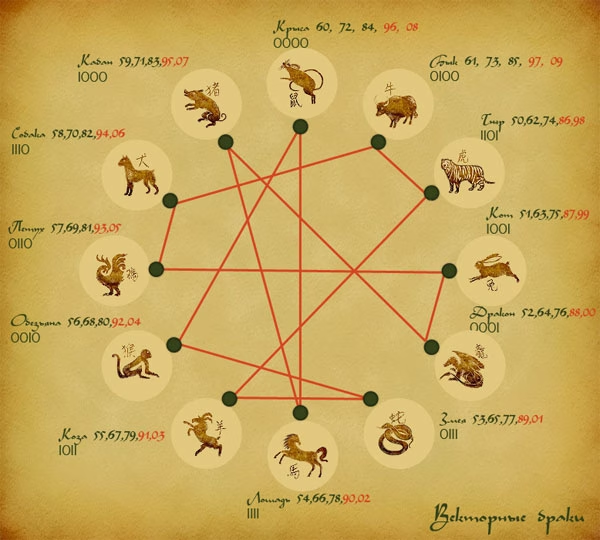
Now it’s time to become acquainted with the vector ring couples (the first position is assigned to the Master):
1. Rat-Horse;
2. Horse-Boar;
3. Boar-Dragon;
4. Dragon-Rabbit;
5. Rabbit-Rooster;
6. Rooster-Dog;
7. Dog-Ox;
8. Ox-Tiger;
9. Tiger-Goat;
10. Goat-Snake;
11. Snake-Monkey;
12. Monkey-Rat.
That is:
1. For the Rat, Master is Monkey, Servant is Horse;
2. For the Ox, Master is Dog, Servant is Tiger;
3. For the Tiger, Master is Ox, Servant is Goat;
4. For the Rabbit, Master is Dragon, Servant is Rooster;
5. For the Dragon, Master is Boar, Servant is Rabbit;
6. For the Snake, Master is Goat, Servant is Monkey;
7. For the Horse, Master is Rat, Servant is Boar;
8. For the Goat, Master is Tiger, Servant is Snake;
9. For the Monkey, Master is Snake, Servant is Rat;
10. For the Rooster, Master is Rabbit, Servant is Dog;
11. For the Dog, Master is Rooster, Servant is Ox;
12. For the Boar, Master is Horse, Servant is Dragon.
Thus, we obtain 24 marriages whose lives do not conform to the essence of the signs and, accordingly, to their ways of thinking. Their development is influenced by mystical structures, ignoring the will and desires of the individuals involved. One can roughly characterize the relationships within such a ring. However, one cannot guarantee that an identical union in another couple will evolve and live according to the same scenario; there is a high probability they will choose their own—original—path.
Any other union will hardly experience the spectrum of feelings characteristic of a marriage within the vector ring, composed of the highest emotional highs and raw nerves. Stability, calmness, and peace are distant from such a marriage, and above all, these qualities cannot be introduced into it. Finding themselves in such a union, partners plunge into an abyss of sensuality and emotions, losing their reason—the ring, like quicksand, pulls them in with increasing force. The couple may consider breaking up, but the time spent together will linger in memory like an open wound of ambiguous recollections and feelings.
It is quite possible that in such a marriage, the Master’s harshness combines with the Servant’s adoration and unconditional forgiveness. There are numerous cases when a couple cannot live together, yet life apart is unbearable for them. They resemble two magnets—sometimes attracting, sometimes repelling each other under the pressure of intense passions.
There is a “rescue” for such unions—the couple should be of significantly different ages, or the female Servant must be able to adapt to circumstances and endure the tensions of passion.
Until the Master decides to let go, the Servant cannot leave on their own. If the Servant departs without permission, it is entirely possible they will suddenly rise in life, yet (also quite likely) remain internally dependent on their former Master. Therefore, if you and a potential partner form a vector ring couple, before deciding to enter a relationship, ask yourself: do you have the strength to make the leap, without knowing whether a parachute awaits behind your back?
Towards the end, thoughts turn to lines from the relationship of V. Bryusov (Rooster) and N. L’vova (Rabbit):
The Servant Bryusov addressed his Master:
Love leads to one thing –
You who love, believe!
Through sorrow and joy, light and darkness
To blissfully terrifying death!
Comparing love to death… there is much to ponder…