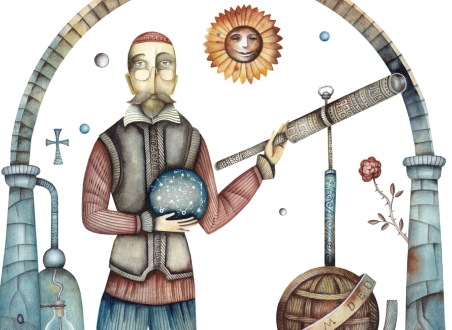

Knowing their positions at a specific time, astrologers venture to predict the future and, upon reflection, successfully prophesy. After all, the Sun in March causes plants to grow, while the Moon, at a certain point, governs tides. Adherents of astrology also claim that the planetary configuration at the moment of someone’s birth can program their character and certain events in their life.

Alongside astrological signs, so-called horoscopic astrology (personality astrology) is widely known, which in turn is based on the idea of a person’s free will in choosing their fate, the options of which are embedded in the birth chart. Any chain of events can be interrupted or altered by human free will. Cautionary information gives a person the right to choose, which can lead to one outcome or another.
Scientists believe that the first records of horoscopes (the oldest texts of the Avesta, burned by Alexander the Great during the conquest of Persia) formed the basis of Zoroastrianism. The planetary circle was divided into 12 arcs of 30 degrees each, each corresponding to an allegorical (zodiacal) symbolism. Accordingly, people’s births and their character traits are differentiated into 12 calendar segments.
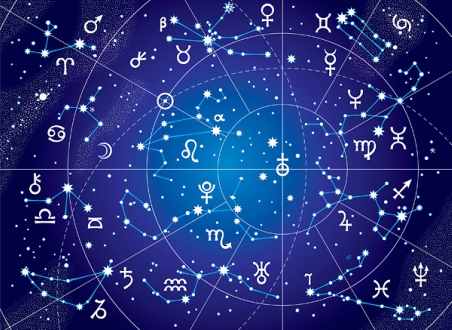
Horoscopes gained popularity, in which a person’s fate is outlined based on the time and place of birth. The Zodiac signs are classified into four groups of elements: fire, earth, water, and air. Based on the strength of expression of their inner zodiacal qualities, the signs are divided into three groups: weak (Sagittarius, Pisces, Gemini, Virgo), moderate (Leo, Scorpio, Aquarius, Taurus), and strong (Aries, Cancer, Libra, Capricorn).
In ancient times, astrology represented one of the main components of mystery rites. For example, one manifestation of astrological ritual was a circle dance mimicking the path of the planets. The mythological school interpreted many works of world culture through the prism of astrology. In particular, the Bible is deciphered as an astrological description: the Twelve Apostles are interpreted as the 12 months, the thirty pieces of silver as the 30 days of the month, Christ as the Sun, his Nativity as the solstice, and so on.
Astrology is closely intertwined with sciences and religions, ancient spiritual practices, and modern personality development techniques.
It makes sense to view astrology as a philosophy that helps to better understand the cause-and-effect relationships of various phenomena. Thanks to astrological forecasts, one can grasp the subtle interconnections of different life spheres, incomprehensible from a rationalist perspective and unique to each individual; gain perspective and a broad view of the situations in which you find yourself. Astrology can give you the opportunity to feel the cosmic order in what seems like chaotic life. After all, it is precisely this sense of order that provides the strength to restore self-confidence, to find peace and tranquility of mind.
Our expert astrologers and consultants can help you delve deeper into astrology, offer sound advice—feel free to call them.